
Construction
Specification
Soundboard – Master grade European Spruce
Back and Sides – Indian Rosewood
Neck – Carbon reinforced Brazilian Mahogany or Flame Maple
Neck backstrap – optional
Two way adjustable truss rod
Fingerboard – Ebony
Mother of Pearl face and edge dots
Bridge – Ebony
Saddle – fully compensated bone
Nut – Bone
Machine Heads – Gold-plated Gotoh SGL510
Tailpiece – 2mm Solid Brass
Woods
It really does pay to get the very best wood you can afford. I use only the finest quarter sawn solid woods for the instrument and it’s kept in the workshop at a controlled temperature and humidity level (around 50% RH @ 70°f). This building environment is important to ensure that the finished instrument can cope with the natural changes in humidity and temperature and ensures a completely stable instrument when built.
The woods I use have been chosen as a result of many years’ experimentation by instrument makers past and present. They are not random choices but are used to provide the specific qualities required of a particular instrument. The chosen woods will be the ones most appropriate for the sound, tone and projection that I am trying to achieve.
Soundboard: European Spruce
In any acoustic musical instrument, the soundboard is the one component that really has to work hard! With the internal bracing pattern, it has to be able to support the compression force from the strings and transmit the vibrations from the strings through the bridge into the sound that you hear. Most of the tone and volume is generated from the top. I make most of my instruments with European Spruce due to its overall power, projection and tonal qualities. It is creamy white in colour with a lovely even grain pattern, has great projection and vibrancy with good tonal clarity and balance. There is an even warmth to the tone and it has great sustain.

Back and Sides: Indian Rosewood
The back and sides of a bouzouki with the soundboard complete the body. While the soundboard generates the majority of the tone and voice of the instrument, the sides and the back in particular provide the complexity and colour to the tone. The density of the wood used for the back and sides and its ability to reflect the vibrations from the top will have its own influence on the tonal character of the instrument. For my instruments, I favour Indian Rosewood. It is a hard and dense wood with wonderful colours of rich browns and purples, often with a striking grain pattern. Indian Rosewood is very resonant with great sustain, rich warm tonal colour and clarity with complex overtones.

Neck, Fingerboard and Bridge
The choice of wood for the neck is really important. It has to be light in weight, but also stiff, strong and above all stable. I find that quarter sawn Brazilian Mahogany is the best wood. Light in weight, it is also very stable and strong, it’s the ideal wood. It is also dense, really important for a good sustain. Maple or Flame Maple is also a great wood and should be considered.
I also inlay two carbon fibre rods into the neck just below the fingerboard. This greatly improves the stiffness and sustain. Necks also have a two-way truss rod.
Fingerboards are from Ebony, a very dense and durable black wood, it is the ideal choice for resisting wear and tear and also adding mass and stiffness to the neck.
The bridge is a really important component in a bouzouki. Its purpose along with the saddle is to support the strings at the correct height above the soundboard and to transfer the vibrations of the strings into the soundboard efficiently and with minimal loss of energy. Ebony is the best wood to use.
General notes on the construction
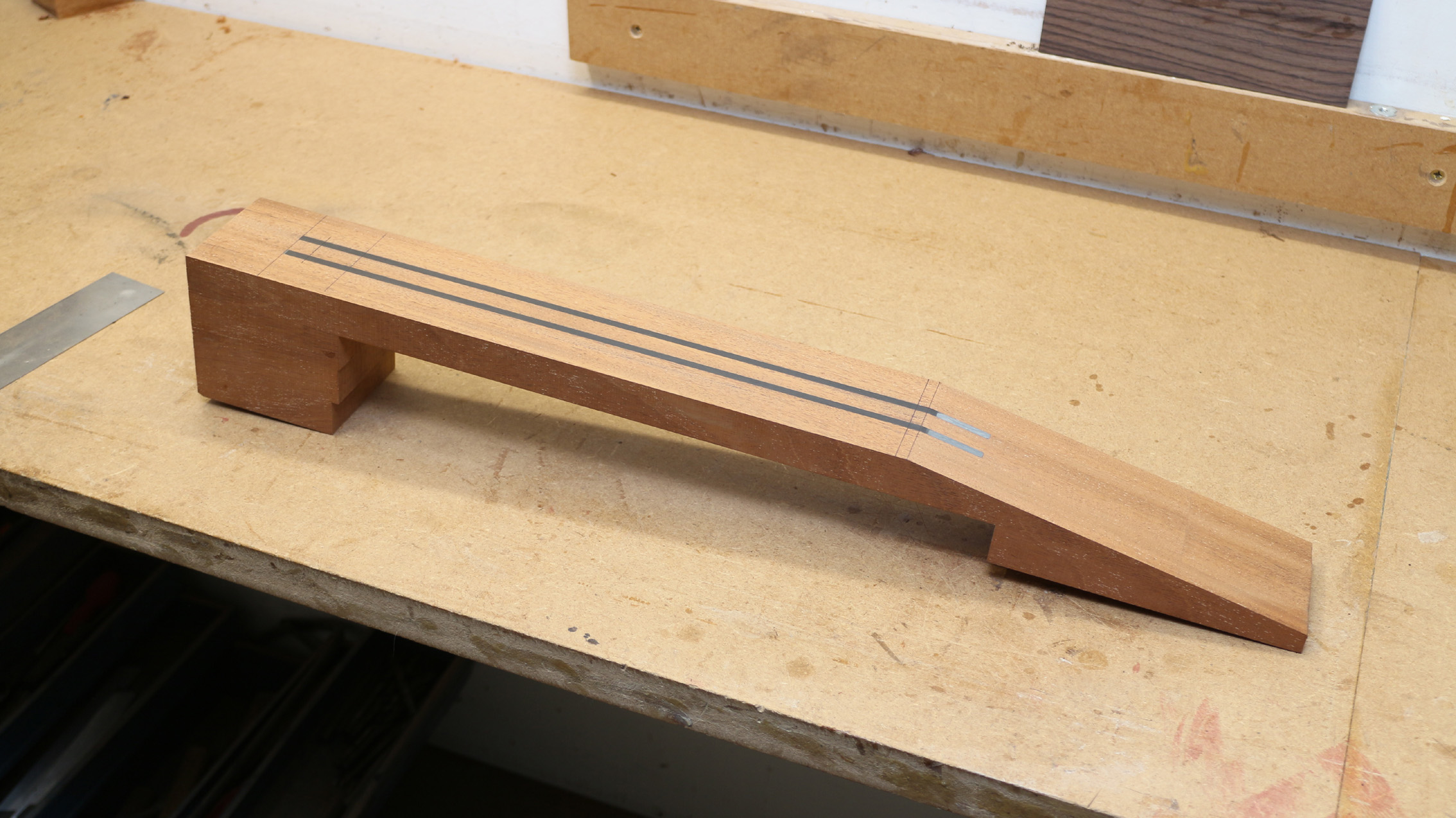
Neck under construction showing inlaid carbon rods.
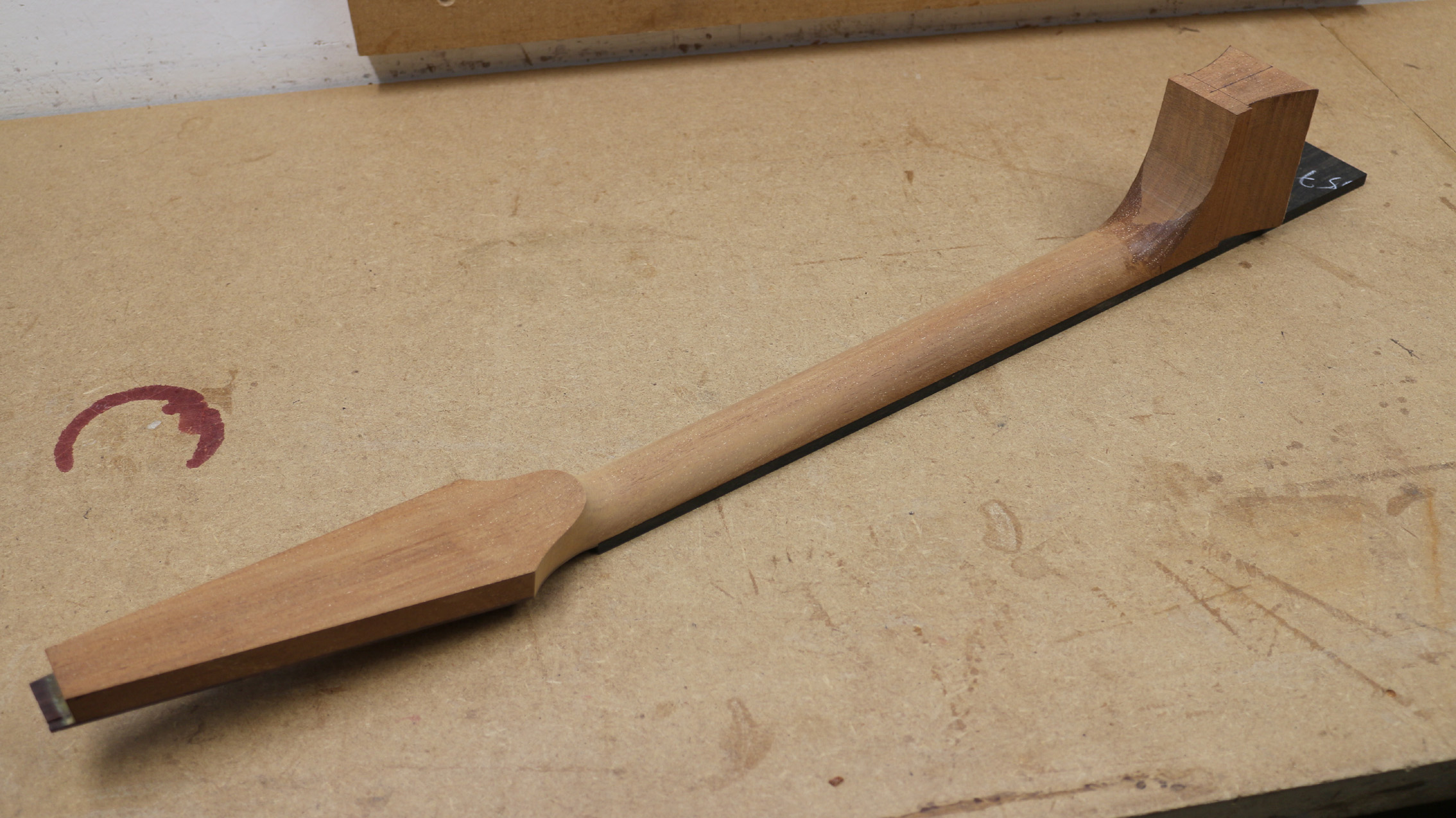
Finished neck with integral block ready to be fitted into the build jig.
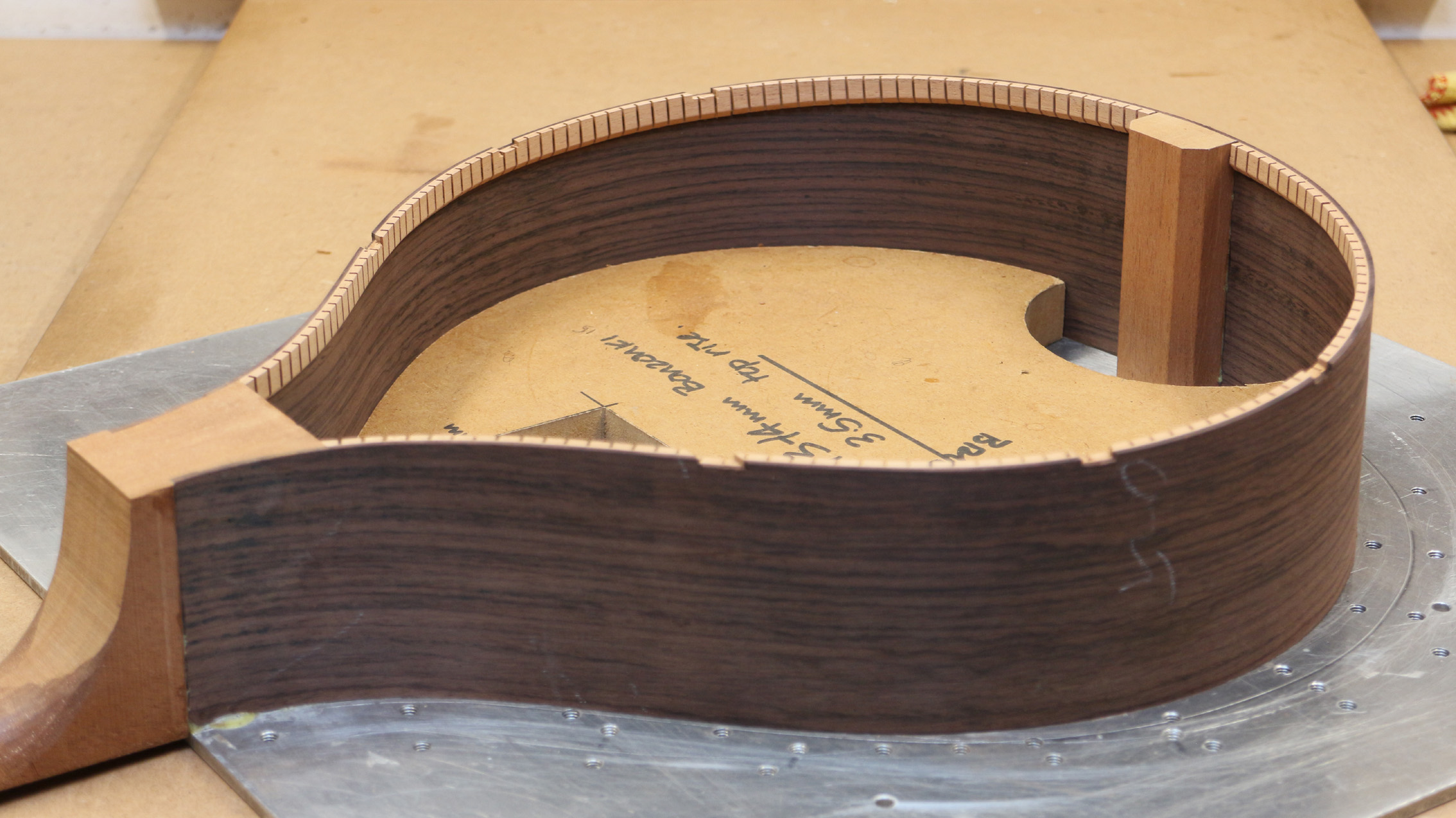
The neck and body under construction in the build jig, ready for the back to be fitted.
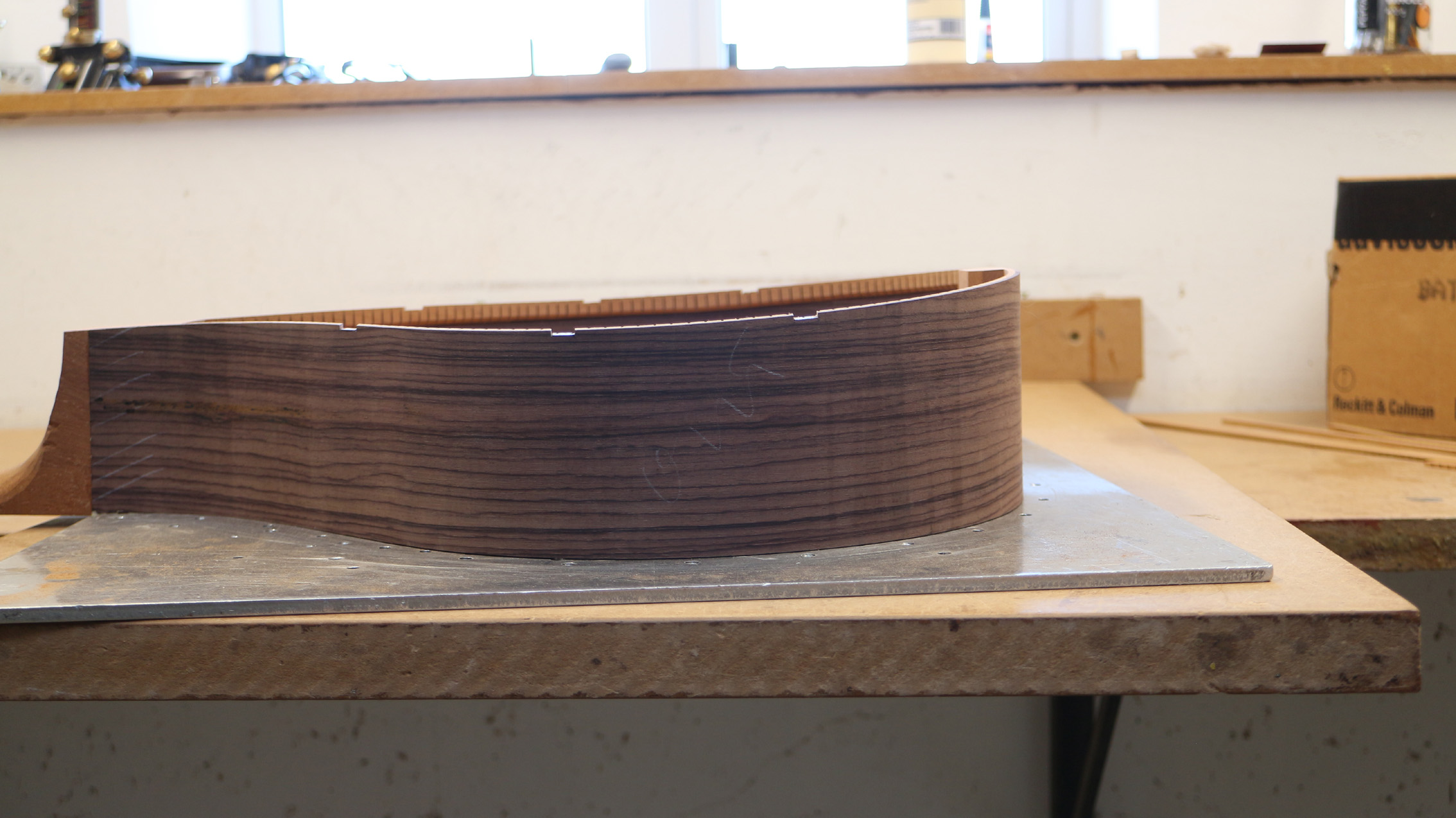
I use a cylindrical back, meaning that the finished back is highly radiused, but in one plane only. This allows the back bracing to be much lighter as it only has to support a curve in one direction. It also means that the back can be thinner, and a much more active component, reducing weight and improving response and tone. The sides need to be profiled to accommodate the radius of the back.
Top bracing
I use an asymmetrical transverse system of bracing the tops. There are good reasons for using this system. A bouzouki will usually have a floating bridge, as opposed to a guitar style glued bridge. This means that the forces that the top has to cope with are completely different from a guitar. Essentially the top on a bouzouki is under a compression force, where the tension in the strings is trying to push the bridge into the body. In a guitar the tension in the strings is trying to rip the bridge off the body in the direction of the nut. In other words, the difference between compression and shear force.
This means that in a bouzouki the top bracing should be designed to resist this compression force. A guitar style X bracing is ideal for resisting the shear force, but is not designed for coping with compression, especially when the X has a weak half lap joint directly under the bridge.
A transverse bracing design has two main lateral braces running width ways placed either side of the bridge. I also fit a bridge plate and couple of small braces either side of the soundhole adding more support in this area.
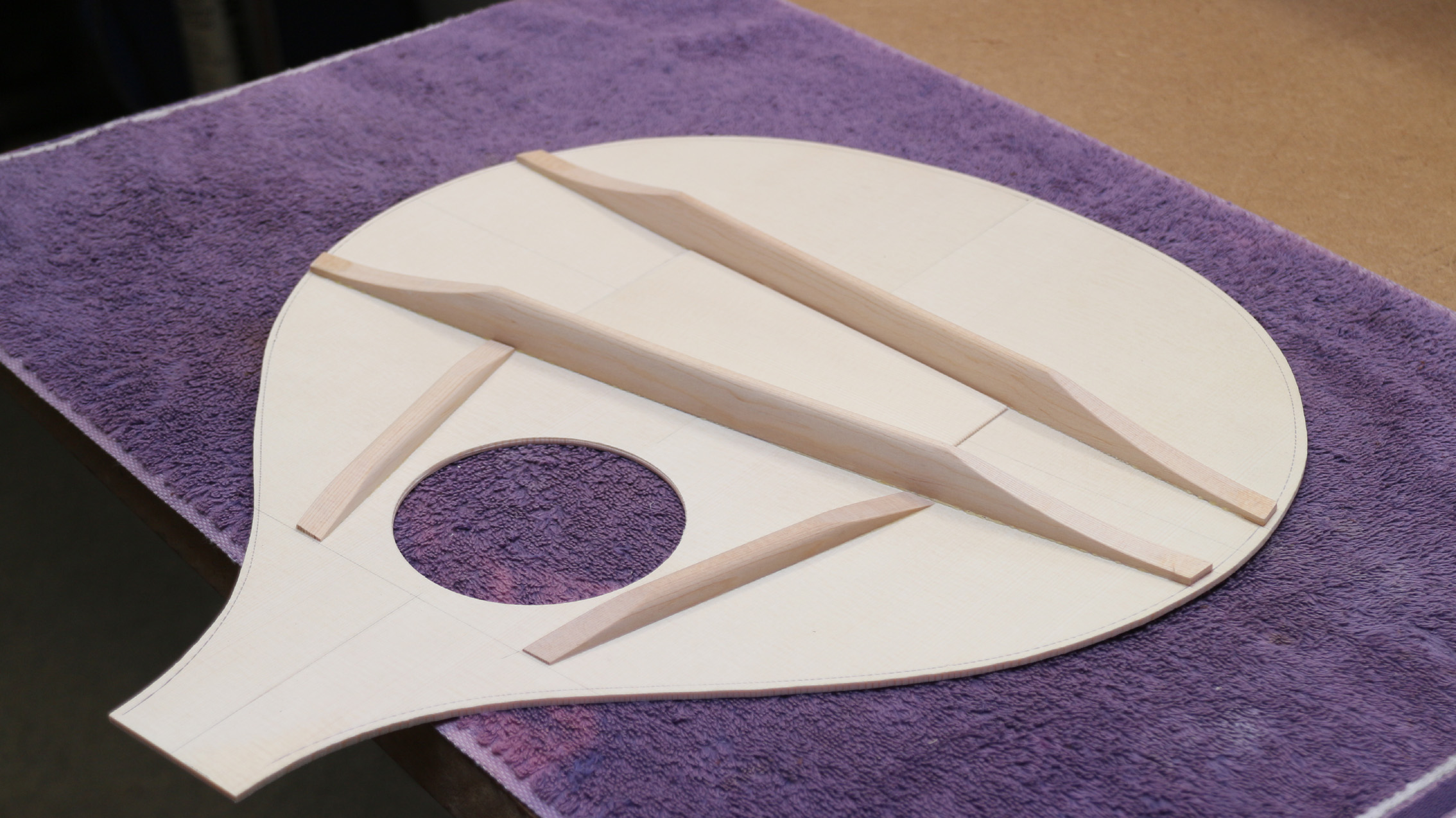
The top ready for fitting to the body.